
China built the category. America learned how to monetize it. India, Latin America and Southeast Asia are now scaling it to hundreds of millions of viewers. The next phase of vertical entertainment will be decided globally and increasingly, in multiple languages.
For an entertainment format that is watched one or two minutes at a time, vertical micro-drama has become a remarkably large business.
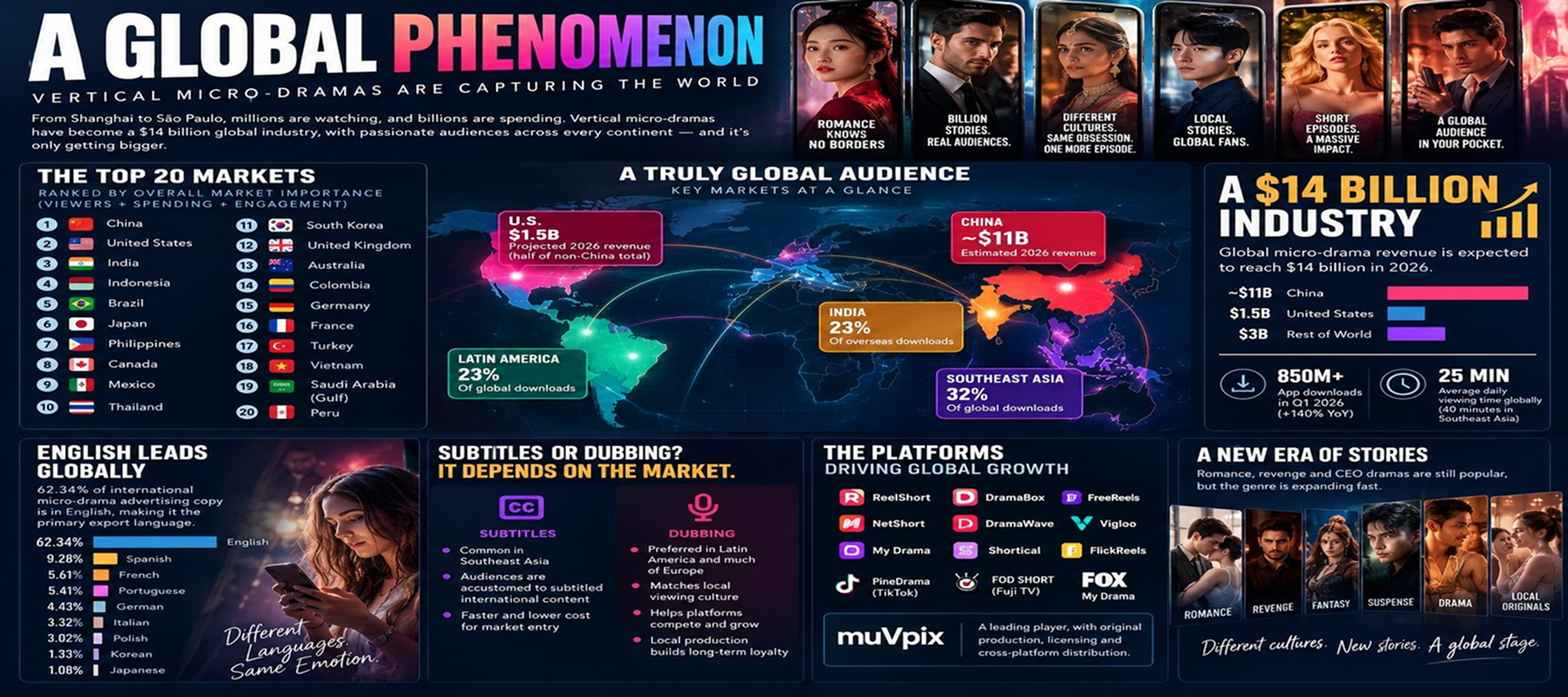
The often-quoted $14 billion figure is legitimate, with an important qualification: research firm Omdia estimates that global micro-drama revenue reached approximately $11 billion in 2025 and will reach $14 billion by the end of 2026. About $3 billion of the 2026 total is expected to come from outside China, with the United States alone accounting for roughly $1.5 billion—or half of all non-Chinese revenue. By implication, China still represents roughly $11 billion of the worldwide business. Omdia That makes vertical drama far more than a Hollywood experiment.
It is now a genuinely global entertainment economy.
And perhaps the most interesting thing about the international market is that the countries producing the most viewers are not necessarily the countries producing the most money.
First, a word about the numbers
Micro-drama statistics can appear contradictory because different companies measure different things.
Sensor Tower reported that short-drama apps generated more than 850 million downloads in Q1 2026 alone, up 140% year over year, while estimated in-app-purchase revenue reached approximately $750 million for the quarter. By April, users globally were spending around 25 minutes per day inside short-drama apps, up 85% from January 2025. In Southeast Asia, daily engagement was approaching 40 minutes. Sensor Tower
DataEye separately estimated approximately 1.44 billion overseas short-drama app downloads during the first half of 2026, with about $1.27 billion in app-store in-app-purchase revenue outside China. 36Kr Meanwhile, Adjust and Sensor Tower data show short-drama apps generated roughly 2.3 billion downloads and $2.98 billion in app-store IAP during 2025. Adjust None of those figures contradict Omdia's $14 billion estimate. App-store IAP is only one piece of the industry. The larger number includes a much broader ecosystem of advertising, direct payments, web purchases and China's enormous domestic micro-drama economy.
That distinction matters when we start talking about the world's largest markets.
The Global Top 20
There isn't yet a single authoritative database that ranks 20 countries using identical measurements of audience, spending and engagement. So the following is a blended ranking of overall market importance, using the latest available 2026 download, revenue and engagement data. The highest positions have substantial evidence across multiple datasets; the final few are emerging markets whose exact positions move month to month.
What jumps out immediately is that there are effectively two different world maps.
The money map is led by China, the United States, Japan, Canada, Korea, the United Kingdom and Australia.
The audience-growth map is increasingly dominated by India, Indonesia, Brazil, the Philippines, Mexico, Thailand, Colombia and Vietnam.
That creates an enormous strategic opportunity for platforms capable of marrying Western monetization with emerging-market scale.
English Is Still the International Language of Vertical Drama—but That Is Changing
Chinese-language content dominates the enormous domestic Chinese market. But once vertical drama leaves China, English becomes the industry's primary export language.
SocialPeta analyzed micro-drama advertising during 2025 and found that 62.34% of international micro-drama advertising copy was in English. Spanish represented 9.28%, French 5.61%, Portuguese 5.41%, German 4.43%, Italian 3.32%, Polish 3.02%, Korean 1.33% and Japanese 1.08%. InvestGame.net
There are several reasons.
First, the United States remains the industry's most valuable market outside China.
Second, an English master can travel across the U.S., Canada, the U.K., Australia and many other territories before any additional localization occurs.
Third, English remains widely understood as a second language in many high-growth mobile markets.
But that doesn't mean international viewers necessarily want to watch everything in English.
In fact, one of the most important developments in vertical entertainment is the industry moving from translation to true localization.
Subtitles or Dubbing? The Answer Depends on the Country
There isn't a universal rule saying foreign audiences prefer subtitles or dubbing.
The better answer is: local viewing culture determines the winner.
In much of Southeast Asia, audiences have decades of familiarity with subtitled Korean, Japanese, Chinese, American and other imported entertainment. Subtitles can therefore be a perfectly viable first localization strategy.
In markets such as Brazil, Mexico and much of Latin America as well as Germany, France, Spain and Italy dubbing has traditionally played a much larger role in mainstream imported entertainment. Vertical platforms are increasingly following that behavior rather than trying to change it. Axis AI Studios
Look at what ReelShort is already doing. Its Spanish-language service prominently labels dubbed titles and Latino productions, while its Brazilian Portuguese service separates dubbed programming from shows produced specifically for Brazilian audiences. ReelShort That may ultimately be the bigger lesson.
Subtitles allow a platform to enter a market. Dubbing allows it to compete more aggressively. Local production allows it to become part of the culture.
Vertical drama appears to be following the same progression Hollywood experienced internationally only dramatically faster.
There is evidence that local production is already becoming increasingly important. One industry analysis found that by Q1 2025, 80% of the top 20 internationally monetizing vertical titles were locally produced rather than merely translated imports. Real Reel For platforms thinking globally, localization therefore shouldn't begin and end with changing the words at the bottom of the screen.
Casting, locations, cultural references, humor, social class, romance conventions, music and even what constitutes an acceptable villain can change from territory to territory.
Southeast Asia May Be the Most Important Region Nobody in Hollywood Is Talking About
In Q1 2026, Southeast Asia represented 32% of global short-drama app downloads. Latin America accounted for another 23%, while India represented 22%.
Together, those three markets generated more than three-quarters of worldwide short-drama downloads during the quarter. Sensor Tower
Even more remarkable is the engagement.
Sensor Tower found that average short-drama viewing in Southeast Asia was approaching 40 minutes per day by 2026—roughly comparable with traditional OTT viewing behavior in the region. Campaign Post
That number deserves attention.
A format originally built around 60- to 90-second episodes is no longer necessarily producing 90-second viewing sessions.
People are bingeing.
The individual episodes are short. The relationship with the viewer is not.
Latin America Could Become Vertical Drama's Next Production Engine
Brazil, Mexico and Colombia now consistently appear in international short-drama data.
Brazil in particular has something almost every platform wants: massive audience acquisition plus demonstrated willingness to spend.
There is also a natural cultural fit. Latin American television has spent generations perfecting emotionally heightened serialized storytelling, romantic conflict, betrayal, family secrets, class division and cliffhangers.
Vertical drama didn't invent those mechanisms.
It put them into a smartphone.
That makes the transition from the telenovela to the micro-drama less radical than it might initially appear.
The next step is already happening: international platforms are beginning to commission more Spanish- and Portuguese-language originals rather than simply dubbing English or Chinese shows.
The Platform Race Is Getting Much Bigger
For several years, the international conversation centered primarily on ReelShort and DramaBox. They remain formidable. In Q1 2026, Sensor Tower estimated that both were generating approximately $140 million each in quarterly in-app revenue. Sensor Tower But the competitive landscape is expanding quickly.
FreeReels became the world's most-downloaded short-drama app in Q1 2026 with more than 100 million quarterly installs. NetShort grew downloads 196% quarter over quarter. DramaWave, Vigloo, My Drama, Shortical, FlickReels and others are building meaningful positions. Sensor Tower And then the technology giants arrived.
TikTok launched PineDrama in 2026, initially in the United States and Brazil, creating a dedicated home for serialized micro-fiction from a company that already helped teach the world how to consume vertical video. TechCrunch Its potential became apparent quickly. Issa Rae's Hoorae Media launched Screen Time through TikTok and PineDrama, generating nearly 75 million views during its first week. TheWrap Japan's Fuji Television launched FOD SHORT in North America in April 2026 and announced plans to ultimately expand into more than 100 countries and regions. Fuji TV FOX Entertainment has partnered with HOLYWATER's My Drama, including turning Farmer Wants a Wife into a 101-episode mobile-first adaptation. Holywater Tech Traditional Hollywood talent, studios and investors are entering as well, while Reuters has reported growing activity from companies connected to FOX, NBCUniversal and established entertainment executives. Reuters And among the new generation of American vertical companies is muVpix, which has taken a somewhat different approach: combining its own destination platform with original production, licensing and wider cross-platform distribution.
A strategic agreement announced with BuzzFeed Studios calls for more than 100 vertical titles over two years, with content conceived for distribution across environments including TikTok, Instagram Reels, YouTube Shorts, FAST/CTV and muVpix itself. That puts muVpix among the emerging American players attempting to build vertical entertainment not simply as an app category, but as a broader content and distribution business. BuzzFeed That distinction may become increasingly important.
The eventual winner of vertical entertainment may not simply be whichever company owns the biggest app.
It may be the company that understands how to make one piece of intellectual property travel across apps, social platforms, languages, territories and screens.
The Business Model Is Changing Too
The original international micro-drama playbook was relatively straightforward: give viewers several episodes for free, reach a cliffhanger, and sell coins or episode unlocks.
That model remains important.
But it is no longer the only model.
Advertising-supported viewing is expanding. Subscription models are appearing. Hybrid ad-plus-IAP businesses are growing. TikTok can use vertical drama to increase engagement in an ecosystem already monetized through advertising. Platforms can use YouTube as both a discovery engine and a revenue source. Brands can be integrated directly into stories. Successful intellectual property can move into longer-form television, film, books, games or commerce.
DataEye reported that in August 2026, more than 80% of active overseas short-drama apps and web products it tracked used either pure IAP or hybrid free-plus-IAP monetization, while purely advertising-supported products were growing at the fastest monthly rate. 36Kr In other words, the industry is moving from a single monetization trick into a genuine media business.
The Genre Is Globalizing Along With the Audience
For years, the stereotype of vertical drama was fairly easy to describe:
Billionaire CEO. Contract marriage. Werewolf Alpha. Secret baby. Revenge.
Those stories aren't disappearing, but the audience is beginning to broaden.
DataEye's August 2026 advertising analysis found emotional stories remained the largest category at 38%, while revenge, counterattack and urban stories were also major categories. More interestingly, CEO, werewolf and "war god" themes fell out of the top ten while fantasy, suspense and tragic romance moved in. 36Kr
That is what should be expected as the medium expands.
Television did not remain one genre.
Film did not remain one genre.
Streaming did not remain one genre.
There is little reason to believe vertical storytelling will.
So What Happens Next?
The first chapter of international micro-drama was about exporting a successful Chinese business model.
The second was about producing English-language verticals for America.
The third chapter is considerably bigger.
It is about Brazilian verticals for Brazil. Spanish-language originals for Latin America. Japanese verticals for Japan. Indonesian stories for Indonesia. Hindi and regional-language dramas for India. Arabic originals for the Middle East. Korean micro-series drawing on the storytelling infrastructure that already made K-drama global.
At the same time, the best stories will travel in the opposite direction—moving between cultures through subtitles, dubbing, adaptation and complete local remakes.
The smartphone has effectively created a new television network with billions of screens.
There is no prime-time schedule.
There are no national borders built into the technology.
And there is no requirement that tomorrow's biggest show originate in Hollywood, Seoul, Mumbai, Jakarta, São Paulo or Shanghai.
It simply has to make someone watching on a phone say:
"One more episode." That may be the most important reason the $14 billion micro-drama market still feels like it is only getting started. Omdia



.png)

Join the Conversation
Be respectful and constructive. Please review our Community Guidelines before posting.
No comments yet. Be the first to share your thoughts.