
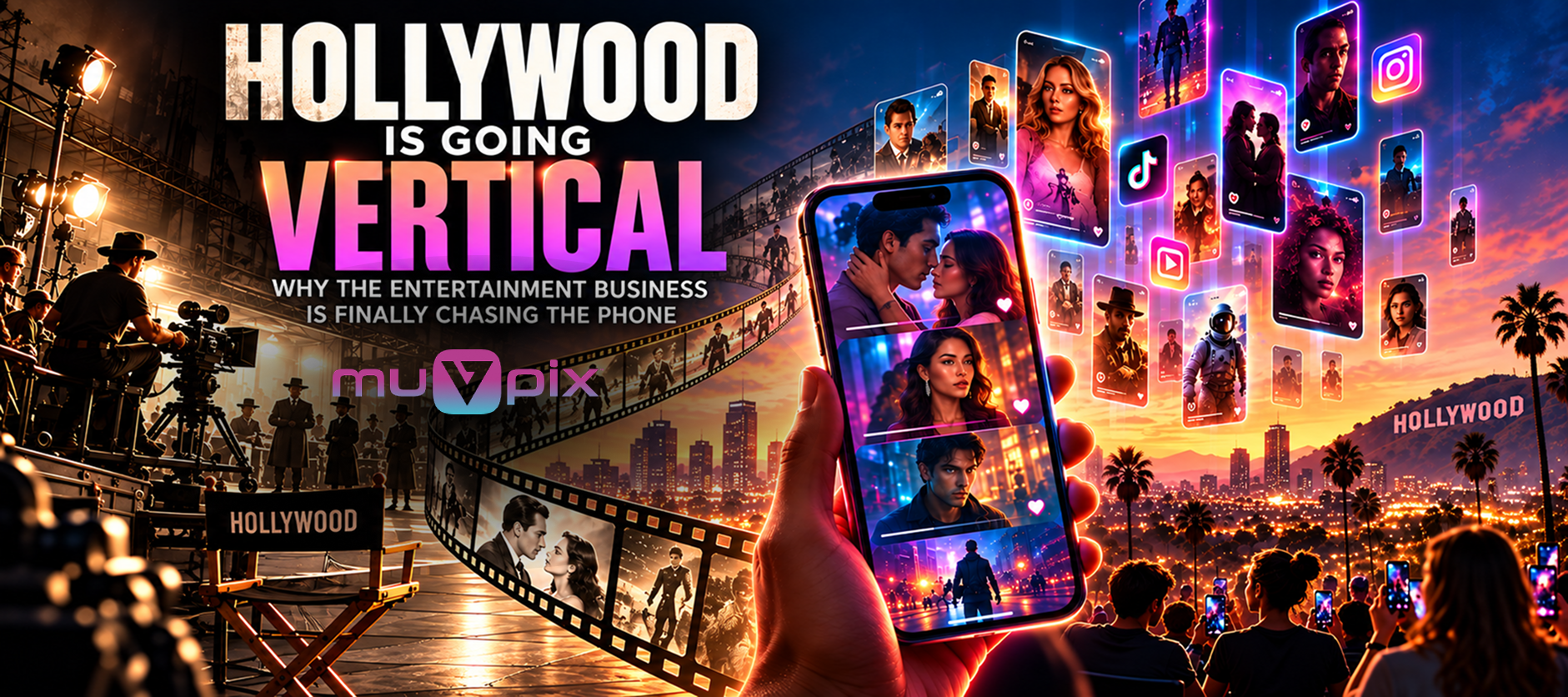
Hollywood Is Going Vertical: Why the Entertainment Business Is Finally Chasing the Phone For more than a century, Hollywood built entertainment around one basic assumption: the audience would come to the screen.
First it was the movie theater. Then television. Cable followed. Then streaming changed everything again.
Now the screen is already in your hand.
And Hollywood is beginning to take that screen very seriously.
Vertical entertainment scripted stories created specifically for the way people naturally hold and consume content on their phones—is rapidly moving beyond its reputation as a niche corner of entertainment.
The bigger story in 2026 isn't simply that vertical dramas are popular.
It's who's entering the business—and how aggressively they're entering it.
Hollywood Is Making Its Move
The signals are becoming difficult to ignore.
Peacock has moved into made-for-phone vertical entertainment, introducing original microdramas alongside licensed titles in genres including romance, fantasy, young adult and melodrama.
FOX Entertainment has made a major commitment through its relationship with HOLYWATER, including an ongoing portfolio expected to encompass more than 200 vertical titles over two years. A separate collaboration involving FOX Entertainment, HOLYWATER and Dhar Mann Studios announced an initial 40-title scripted vertical slate.
Organized labor has taken notice as well. SAG-AFTRA now has an agreement specifically designed for serialized vertical productions, creating a framework around the unique schedules, episode structures and economics of the format.
And another aggressive move came from two companies already deeply rooted in digital-first audiences:
BuzzFeed Studios and muVpix announced a strategic partnership centered around the production of more than 100 live-action vertical series over two years.
Put these developments together and something becomes clear:
This isn't one company experimenting with a new format.
An ecosystem is forming.
100 Series Is Not an Experiment
The scale of the BuzzFeed Studios and muVpix agreement is particularly interesting because of what it says about where the vertical business may be heading.
One vertical series can be an experiment.
Five can be a slate.
More than 100 is an infrastructure decision.
The partnership brings together companies approaching the market from different directions.
BuzzFeed spent years learning how stories, personalities and cultural moments move through social media. Its brands have reached enormous digital audiences, and the company understands the mechanics of content designed to be discovered, shared and discussed online.
muVpix comes from the other side: a dedicated vertical entertainment platform built around serialized mobile storytelling.
Combine production, marketing, a vertical-native platform and broader social distribution, and the strategy begins to look different from simply producing another collection of short dramas.
It starts looking like a pipeline.
Importantly, the announced slate is centered around live-action production.
That's worth watching.
AI Is Growing. So Is the Value of Human Performance.
Any conversation about entertainment in 2026 inevitably reaches artificial intelligence.
AI-generated entertainment is improving rapidly. It can reduce production costs, create environments that would otherwise require enormous budgets and allow creators to produce certain kinds of content at unprecedented speed.
Vertical entertainment will almost certainly be one of the places where that technology is tested most aggressively.
But the simultaneous investment in live-action vertical production suggests another possibility:
As synthetic content becomes easier to create, authentic human performance may become more—not less—valuable.
Actors looking into each other's eyes. Chemistry between performers. The slight hesitation before a line. A director recognizing something unexpected in a scene and allowing the camera to keep rolling.
Those moments have powered storytelling for generations.
Technology may change the canvas.
Human emotion remains the product.
Vertical Doesn't Mean Turning the Camera Sideways
One of the biggest misconceptions about vertical entertainment is that it's simply traditional television shot in 9:16.
The successful shows suggest otherwise.
Vertical storytelling has developed its own grammar. Episodes can last only a minute or two. Characters must establish themselves quickly. Exposition has to move. Conflict arrives early.
And perhaps most importantly, the cliffhanger isn't something that happens once before a commercial break.
It's built into the architecture of the series.
Every episode has two jobs: tell part of the story and make it almost impossible not to watch the next one.
That changes writing, editing, directing, performance and even how producers analyze whether a story is working.
Traditional television spent decades learning how to stop viewers from changing the channel.
Vertical entertainment faces a more ruthless challenge:
Stop them from swiping.
The Phone Is Becoming a Premiere Screen
For years, Hollywood treated the smartphone primarily as a marketing device.
Watch the trailer on your phone. See the clip. Discover the movie. Then go somewhere else to experience the "real" entertainment.
That distinction is disappearing.
TikTok, YouTube Shorts and Instagram Reels have conditioned a generation of consumers to discover entertainment vertically, consume it vertically and share it vertically.
The phone isn't necessarily the second screen anymore.
For many consumers, it's the first.
So perhaps Hollywood has been asking the wrong question.
The question isn't:
Will audiences watch entertainment on their phones?
That question has already been answered.
The more interesting question is:
What happens when major entertainment companies begin creating premium scripted entertainment specifically for that behavior?
That's what the industry is beginning to find out.
A New Door Into Hollywood
There's another part of the vertical story that may ultimately be even more significant.
Jobs.
Traditional film and television production has experienced a difficult period. Changing streaming economics, consolidation and technological disruption have placed enormous pressure on actors, writers, directors and production crews.
Meanwhile, vertical production has been expanding.
Reuters recently examined the growth of microdrama production in Los Angeles against the backdrop of contraction elsewhere in Hollywood, including performers and production professionals finding opportunities in the emerging format.
Every live-action vertical series still needs actors, writers, directors, cinematographers, production designers, editors, costume departments, hair and makeup, composers and producers.
And potentially something Hollywood is always searching for:
new stars.
Vertical entertainment could become another entry point into an industry that has historically been extraordinarily difficult to enter.
An unknown actor doesn't necessarily need to land a network pilot anymore.
A filmmaker doesn't necessarily need someone to hand them $20 million.
An audience can discover them somewhere else first.
Hollywood Can Experiment Again
The economics are also fundamentally different.
Traditional television can take years to develop and millions of dollars to produce before an audience sees the first episode.
Vertical production can move much faster.
That creates something Hollywood has always needed but increasingly struggles to afford:
experimentation.
Try a genre. Introduce an unknown actor. Test new intellectual property. Tell a story for an underserved audience. Enter another country. Experiment with a new filmmaker.
Then watch what audiences actually do.
Not what a focus group says they might do.
What they watch. What they finish. What they share. And whether they immediately watch another episode.
That feedback loop could become one of vertical entertainment's most powerful advantages.
The Next Format Doesn't Have to Kill the Last One
Whenever a new entertainment format emerges, the conversation tends to become unnecessarily binary.
Streaming was going to kill movie theaters. YouTube was going to kill television. Social media was going to kill Hollywood.
Most of the time, something more complicated happens.
New formats don't necessarily replace old ones. They create additional ways to tell stories.
Nobody needs vertical entertainment to replace movies or television for it to become an enormous business.
Movie theaters can deliver spectacle. Television can deliver long-form storytelling. Streaming can deliver enormous libraries on demand.
And vertical can deliver something uniquely suited to the device billions of people carry everywhere:
serialized entertainment designed for the moments between everything else in their lives.
Follow the Audience
Every major transformation in entertainment initially looked smaller than what came before it.
Television was once considered inferior to movies. Cable was secondary to broadcast television. Streaming was once an internet extension of the DVD business.
Then audience behavior changed the economics.
Vertical entertainment is still young. Business models will evolve. Platforms will change. Episode lengths will change. Production values will increase. Genres will expand. Some of today's companies will disappear and new ones will emerge.
That's what happens when a medium develops.
But look at what's happening now.
Peacock is experimenting with original vertical programming.
FOX Entertainment has committed to a large vertical pipeline.
SAG-AFTRA has created a dedicated framework for vertical productions.
BuzzFeed Studios and muVpix are planning more than 100 live-action vertical series together.
Traditional Hollywood actors, filmmakers and production crews are increasingly entering the space.
At some point, enough experiments happening simultaneously stop looking like experiments.
They start looking like a market.
Hollywood has spent more than 100 years following audiences from one screen to another.
The movie screen.
The television screen.
The computer screen.
And now, perhaps the most personal screen of all.
The one already in your hand.

.png)


Join the Conversation
Be respectful and constructive. Please review our Community Guidelines before posting.
No comments yet. Be the first to share your thoughts.